

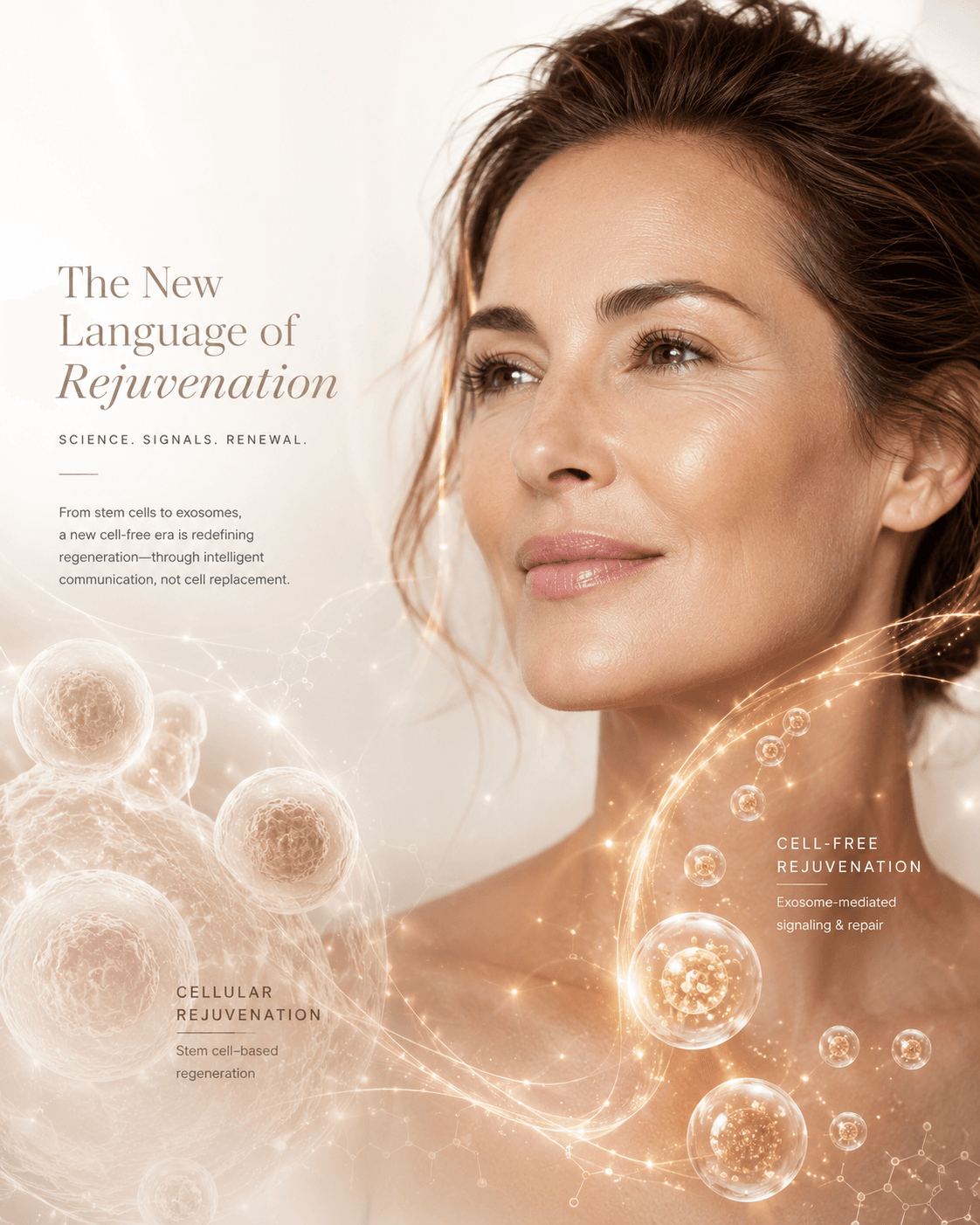
Stem Cells and Exosomes for Rejuvenation: What Is Cell-Free Regeneration?
The meaning of rejuvenation is changing. The goal is no longer limited to a tighter face, fewer wrinkles, or smoother skin. Modern aesthetic surgery increasingly looks beyond anatomy to tissue quality: elasticity, hydration, microcirculation, extracellular matrix integrity, and the capacity to repair. I see this evolution as the meeting point between the anatomical power of surgery and the biological precision of regenerative medicine.
From this perspective, rejuvenation can be discussed in two distinct but potentially complementary biological languages: cell-based strategies and cell-free strategies. Approaches using stem/stromal cells or regenerative components of adipose tissue involve living cells or cell-containing tissue, whereas extracellular vesicles (EVs) carry biological signals used by cells to communicate. In public-facing language, this second field is often grouped under the term “exosome therapy.”
| Scientific terminology note In contemporary EV science, “exosome” is a popular term, but unless endosomal biogenesis has been demonstrated, the broader term “extracellular vesicle (EV)” is scientifically more appropriate. [1] |
1. Two languages in regenerative aesthetics: cells and biological messages
Surgery can reposition descended tissues, remove excess tissue, and restore facial anatomy. Regenerative approaches aim at something different: supporting the biological microenvironment of skin and soft tissue. For that reason, regenerative treatments are better viewed not as substitutes for facelift surgery, blepharoplasty, or other structural procedures, but as possible complementary tools in appropriately selected patients and indications.
Terminology matters. Autologous fat grafting, stromal vascular fraction (SVF), adipose-derived stromal/stem cells (ADSCs), and ex vivo-expanded cell products are not interchangeable. They differ in cell populations, processing, invasiveness, evidence, and regulatory status. Recent systematic reviews suggest that cell-enriched fat grafting may improve graft retention and certain tissue-quality outcomes in some settings, while also emphasizing substantial methodological heterogeneity and the need for longer-term data. [5]
2. What can a stem-cell-based strategy add when combined with surgery?
Adipose tissue is more than a volumizing material. In addition to mature adipocytes, it contains vascular cells, immune cells, connective-tissue cells, and stromal/progenitor populations. This is why fat grafting and selected cell-enrichment strategies can bring two goals into the same discussion: restoring volume and supporting the local tissue environment.
In selected patients, the concept behind combining surgical rejuvenation with regenerative methods is simple: not only to reposition tissue, but also to consider its biological quality. At the same time, the term “stem cell” is often used too broadly in aesthetic marketing. Scientifically, it matters which cellular population is present, how it was obtained, how it was processed, and how it is delivered.
3. What is an exosome — and why may “EV” be the more accurate scientific term?
Extracellular vesicles (EVs) are microscopic, lipid-bilayer-delimited particles released by cells that cannot replicate on their own. They may carry proteins, lipids, enzymes, metabolites, and nucleic acids such as RNA and microRNA, contributing to communication between cells. [1]
An “exosome” is, more specifically, an EV generated through a particular intracellular route involving the endosomal system. The International Society for Extracellular Vesicles (ISEV), in its MISEV2023 guidance, recommends using the broader term extracellular vesicle unless the biogenesis of the vesicle population has actually been demonstrated. In other words, not every commercial preparation marketed as an “exosome” should automatically be assumed to contain a pure, biologically verified exosome population. [1]
4. What does “cell-free regeneration” mean?
The term “cell-free” describes the concept of using biological signals produced by cells rather than transferring living stem cells themselves. The theoretical attraction is the possibility of harnessing aspects of cellular repair communication without administering the cell as the therapeutic entity. This does not mean, however, that cell-free preparations are automatically risk-free, standardized, or equivalent to one another.
The biological behavior of an EV preparation can depend on the source cell, culture conditions, isolation and purification methods, particle number and characteristics, molecular cargo, storage conditions, and route of administration. The word “exosome” alone is therefore not a quality label.
5. What does current evidence say about EVs/exosomes in skin rejuvenation?
A 2026 systematic review focused on human studies found associations between exosome/EV-based interventions and short-term improvements in hydration, elasticity, wrinkle appearance, pores, pigmentation, and overall skin appearance. However, most of the 19 included studies were not randomized, products and delivery methods differed substantially, and long-term follow-up was limited. The field is promising, but there is still no universally validated protocol or predictable effect size. [2]
Another 2026 systematic review highlighted mechanisms involving collagen and elastin synthesis, oxidative stress, and extracellular-matrix remodeling, while similarly calling for larger, standardized trials with longer follow-up. [3]
Clinically, I interpret these findings as a reason to position EV/exosome-based procedures as emerging regenerative tools that may support tissue quality — not as overnight anti-aging miracles.
6. What can be a realistic aesthetic goal — and what cannot?
Depending on the product and delivery strategy, studies have explored endpoints such as skin hydration and radiance, texture, elasticity, the appearance of fine lines, and recovery after selected procedures. These should be communicated as potential, not guaranteed, benefits because outcomes vary with the preparation, the patient, and the technique.
EV/exosome procedures do not surgically lift descended tissues, do not independently replace lost facial volume, and have not been proven to reverse biological aging. Realistic expectations are a central part of responsible regenerative aesthetics.
7. Wound healing, reconstruction, and hair: broad research interest, uneven evidence
EVs are actively studied in wound healing, inflammatory modulation, angiogenesis, and tissue repair. Yet reviews of published clinical studies show substantial heterogeneity in product characterization and study design; controlled evidence for wound healing remains limited and not uniformly conclusive. [4]
Hair restoration is another rapidly developing area. Early clinical studies — particularly in androgenetic alopecia — report signals of improvement in hair density and shaft thickness. Systematic reviews published in 2025 and 2026 nevertheless emphasize small cohorts, variable protocols, and limited follow-up. EV/exosome approaches should therefore not be framed as a universal “replacement for PRP” without first establishing the cause and type of hair loss. [8]
8. Safety and standardization: the question I consider most important
The key question is not only “Does it work?” but also “What exactly is in the product, and how was it characterized?” Relevant quality domains include the source cells, manufacturing conditions, purification method, particle count and size distribution, characterization markers, sterility, endotoxin and mycoplasma testing, storage and transport conditions, and batch-to-batch consistency. MISEV2023 places strong emphasis on transparent characterization and reporting. [1]
GMP-compliant manufacturing is an important quality signal, but “manufactured under GMP” does not by itself prove efficacy for a specific aesthetic indication or mean that a product is authorized for that use in a given country. Regulatory status varies by jurisdiction, product, and route of administration. In the United States, for example, the FDA states that there are currently no FDA-approved exosome products and has warned about serious adverse events associated with unapproved products. [7]
The route of administration matters as well. In the 2026 human-study systematic review, topical applications generally showed a favorable short-term safety profile, while isolated safety concerns were reported with off-label injectable use. [2]
9. Who may be a candidate, and how many sessions are needed?
The more useful question is not “How old are you?” but “What tissue problem are we trying to address?” Photoaging, dryness, barrier dysfunction, fine skin quality, recovery after procedures, the type of hair loss, concomitant treatments, and overall health should all be assessed together.
There is currently no universally accepted EV/exosome dose, particle count, concentration, treatment interval, or number of sessions for aesthetic rejuvenation. Published protocols range from single-session approaches to multi-session combinations. A fixed rule such as “everyone needs two or three sessions” is therefore less scientific than an indication-specific, product-specific, evidence-aligned plan. [2,3]
10. PRP, stem cells, and EVs/exosomes are not the same
| Feature | PRP | Stem-cell / cell-containing approach | EV / “exosome” approach |
| Source | Platelet-rich plasma prepared from the patient’s own blood | Adipose tissue, bone marrow, or other cellular sources depending on the method | Extracellular vesicles released by cells; source cells and manufacturing conditions matter |
| Living cells? | No stem cells; platelets are anucleate cellular elements | Depending on the technique, living cells or cell-containing tissue are present | Cell-free; transfer of living cells is not the intended mechanism |
| Biological concept | Growth factors and other mediators released from platelet granules | Cellular/paracrine effects, vascular support, matrix and tissue interactions | Intercellular signaling through cargo such as proteins, lipids, and RNA |
| Standardization | Varies by preparation system and patient biology | Highly dependent on cell type, isolation, processing, and expansion | Highly dependent on source, purification, particle characterization, purity, and storage |
| Evidence snapshot | Some favorable facial-rejuvenation findings, but reviews describe heterogeneous and often low-certainty evidence. [6] | Promising in selected aesthetic and reconstructive settings, with ongoing standardization and long-term-data gaps. [5] | Early human skin and hair data are encouraging, but stronger randomized, standardized, long-term studies remain necessary. [2,3,8] |
| A simple analogy Think of a stem cell as a biological production-and-response system, and an EV as one of the message packages released by that system. The analogy is useful for communication, but the two are not scientifically interchangeable. |
11. Why the future may belong to hybrid protocols
The strength of aesthetic surgery is its ability to change anatomy directly. The promise of regenerative medicine is its ability to influence the biological behavior of tissues. I expect the future of rejuvenation to be described less by the name of a single device, injection, or operation and more by hybrid strategies that integrate structural correction, volume management, skin biology, and recovery capacity.
As I also emphasize in my book “FİLTRESİZ BİR DÜNYA MÜMKÜN,” my objective in aesthetics is not to turn one face into another, but to support a healthier, more balanced, and more sustainable version of the patient’s own anatomy and tissue biology. EV/exosome science is a new part of that story that deserves both curiosity and discipline. Its real excitement is not that it is a “miracle,” but that it may allow us to translate the language of cell-to-cell communication into clinically useful regenerative strategies.
Frequently Asked Questions
Do EVs/exosomes increase collagen production?
Laboratory, animal, and early clinical data suggest effects on fibroblast activity, extracellular-matrix remodeling, and collagen/elastin-related pathways. Human clinical findings are encouraging, but products and protocols vary, so the same effect cannot be assumed for every preparation. [2,3]
Can they be used in patients with a weak skin barrier?
Barrier support and post-procedure recovery are among the investigated applications. If active dermatitis, infection, marked sensitivity, or another skin disorder is present, diagnosis and barrier status should be assessed first.
Are exosomes an alternative to PRP for hair loss?
Not as a universal replacement. Early clinical findings are encouraging, but the cause of hair loss, EV source, delivery method, and follow-up differ across studies. Stronger head-to-head trials are needed before claiming consistent superiority over PRP. [8]
Is exosome therapy a stem-cell treatment?
No. Stem-cell-based procedures involve living cells or cell-containing tissue. EV/exosome approaches use vesicular biological signals released by cells and are therefore described as cell-free.
How can the quality of an exosome/EV product be evaluated?
Ask about its biological source, manufacturing and purification process, EV characterization, particle counting, purity, sterility/endotoxin/mycoplasma testing, storage conditions, batch analyses, clinical evidence, and regulatory status for the proposed use. The word “exosome” alone is not proof of quality.
Can exosomes replace a facelift?
No. A facelift repositions anatomically descended tissues. EV/exosome-based procedures aim to support tissue biology; they do not perform the structural work of surgery.
Final perspective
The most responsible position in regenerative aesthetics is neither to call every new technology a miracle nor to dismiss an evolving field because its evidence is still maturing. Scientific curiosity and clinical discipline must move together. My goal is to build rejuvenation strategies that remain natural in appearance, anatomically balanced, biologically supported, and individualized to the patient.
| Medical information disclaimer This article is intended for general educational purposes and does not replace individualized medical assessment, diagnosis, or treatment advice. The availability, authorization status, and permitted routes of use of EV/exosome and cellular products vary by country, product, and indication. |
Bilimsel Kaynaklar / Scientific References
Aşağıdaki kaynaklar Türkçe ve İngilizce bölümlerdeki bilimsel çerçeveyi desteklemektedir. / The following references support the scientific framework used in both language versions.
1. Welsh JA, Goberdhan DCI, O’Driscoll L, et al. Minimal information for studies of extracellular vesicles (MISEV2023): From basic to advanced approaches. Journal of Extracellular Vesicles. 2024;13(2):e12404. doi:10.1002/jev2.12404.
2. Flores Rodríguez JC, Toledo Avelar LE, Yi K, et al. Efficacy of Exosome-Based Therapies for Skin Rejuvenation: A Systematic Review of Human Studies. Cureus. 2026;18(2):e104182. doi:10.7759/cureus.104182.
3. Alzahrani A, Alghamdi S, Alahmadi M, et al. Exosomes in Skin Rejuvenation: Systematic Review of Anti-Aging Effects and Clinical Applications. Dermatology Practical & Conceptual. 2026;16(1):6462. doi:10.5826/dpc.1601a6462.
4. Duong A, Giguère P, Shorr R, Allan DS. A systematic review of published clinical studies using cell-derived extracellular vesicles: A focus on efficacy in COVID-19 and wound healing. Current Research in Translational Medicine. 2026;74(1):103557. doi:10.1016/j.retram.2025.103557.
5. Hakami AH, Akkur MS, Mahasi KA, et al. Adipose-Derived Stem Cell, Stromal Vascular Fraction, and Regenerative Cell Enrichment in Fat Grafting: A Systematic Review of Safety and Functional Outcomes. Cureus. 2025;17(12):e99599. doi:10.7759/cureus.99599.
6. Cruciani M, Masiello F, Pati I, Pupella S, De Angelis V. Platelet rich plasma for facial rejuvenation: an overview of systematic reviews. Blood Transfusion. 2024;22(5):429-439. doi:10.2450/BloodTransfus.730.
7. U.S. Food and Drug Administration. Consumer Alert on Regenerative Medicine Products Including Stem Cells and Exosomes; and Public Safety Notification on Exosome Products. Accessed September 2026.
8. Al Ameer MA, Alnajim AT, Al Ameer A, et al. Exosomes and Hair Regeneration: A Systematic Review of Clinical Evidence Across Alopecia Types and Exosome Sources. Clinical, Cosmetic and Investigational Dermatology. 2025;18:2215-2227. doi:10.2147/CCID.S543451.